
The Girl’s Growth into a New Life
The Most Precious of CargoesThis flow follows the rescued girl from a hungry infant to a child with a family, livelihood, public identity, and unknown relationship to her birth father.
increasing Bearing strength in each event
 decreasing
Bearing strength in each eventdecreasingA Newborn in the Snow
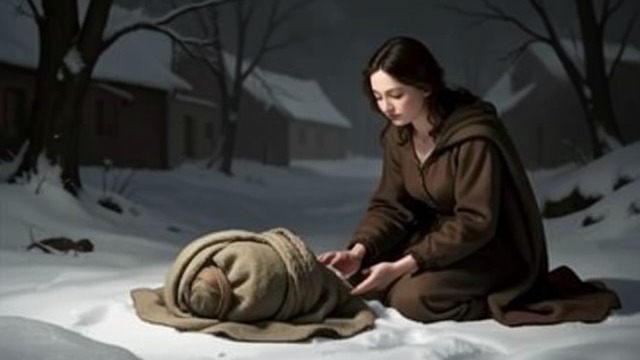
A Newborn in the Snow
Cast from the wagon
The infant is pushed from Convoy 49 in a Prayer shawl and received by Poor Woodcutter’s Wife. She arrives in immediate danger, cold and hungry.
A future with no guarantees
The woman calls her a gift, but love alone cannot feed her. Her survival depends on a chain of unlikely help beginning with the person who runs to pick her up.
A Child Without Milk
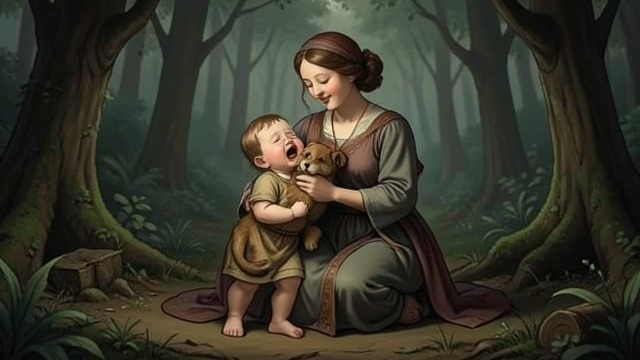
A Child Without Milk
The body’s demands
The baby cannot live on the woman’s hopes or on porridge she rejects. Poor Woodcutter’s Wife searches the forest for a nursing animal.
First care and attachment
Her improvised feeding calms the infant for a time, while her fear grows with each cry. The girl’s vulnerability makes the adoptive bond concrete: she must be kept alive from one meal to the next.
A Daughter of Two Homes
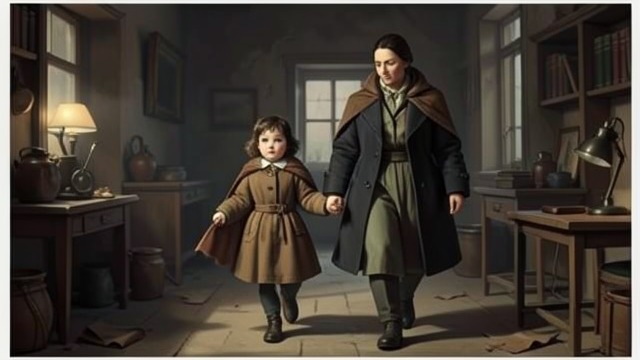
A Daughter of Two Homes
Family life in hiding
The girl grows under Poor Woodcutter’s Wife’s care and eventually wins Poor Woodcutter’s affection. She learns to walk and calls the couple her parents.
A divided origin
Her birth family is absent from her daily life, while the people who shelter her become her home. The story gives her two histories without making either one erase the other.
A Trade Learned Young
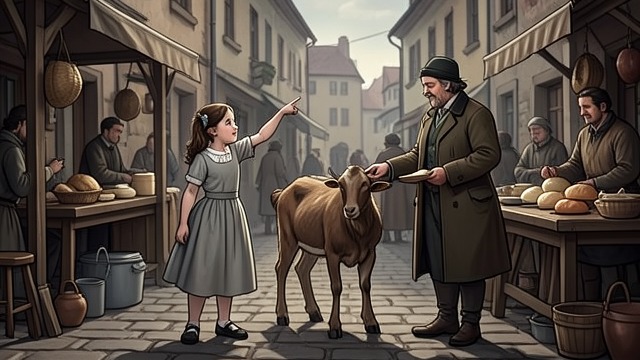
A Trade Learned Young
Living from the goat
The girl accompanies Poor Woodcutter’s Wife as she sells goat cheese in a village square. She helps explain where the cheese comes from and points to the goat beside them.
A place among strangers
The small trade gives the pair a public presence after years of hiding. The girl appears confident and happy, with a practical role in the life that has grown around her.
The Pioneer Photograph

The Pioneer Photograph
A public image
The girl grows into a young pioneer, wearing a red scarf and star. A magazine publishes her photograph as that of a deserving child from a poor household.
A life beyond the rescue
The image presents a happy public identity, but it cannot disclose the child’s origins or her father’s later search. Her future remains hers, even as the past persists beyond what she knows.
March 2, 1943
Her first days in the cabin
During her early childhood in the forest
After the war, in the ruined village
Several years after liberation
